Tuesday, February 28, 2017

UK to boost funding for AI and robotics research

The UK government is set to announce funding for artificial intelligence (AI) and robotics research as part of the government’s strategy to help UK businesses maximize investment and trade opportunities.

Culture Secretary Karen Bradley is expected to make the funding announcement on Wednesday as part of the British government’s digital strategy.

The research, which will be carried out by top British universities, will have a fund of £17.3 million. The grant will come from UK’s Engineering and Physical Sciences Research Council.

The funding support came after recent research revealed the potential long-term impact the AI and robotics field could have on UK’s economy. Accenture, last year, published a report projecting that AI could contribute up to £654 billion to the British economy by 2035.

BenevolentAI CEO Jerome Pesenti, who previously served as chief data scientist at IBM and Computer Scientist Dame Wendy Hall, who is currently a professor at University of Southampton, have been commissioned to review the status of UK’s artificial intelligence sector. The review aims to pinpoint areas of opportunity for UK’s growing AI research industry.

In a statement, Professor Dame Wendy said she was looking forward to exploring collaboration opportunities for the government and the AI sector. She notes that British scientists, researchers and entrepreneurs have been at the forefront of AI research and development.

Demand for British expertise in the artificial intelligence field has skyrocketed in recent years.

In 2014, search giant Google acquired DeepMind, a London start-up that invented a neural network that is capable of that mimicking the short-term memory of the human brain, for $400 million. In 2015, Apple paid $250 million to acquire UK-based start-up, VocalIQ, which specializes in machine learning that enables computers to understand natural human language. Microsoft likewise shelled out $250 million to buy SwiftKey, the London-based developer of a software keyboard with advanced predictive abilities.

A spokesperson for the UK’s Department for International Trade said the government is looking to help UK businesses make the most of trade and investment opportunities through targeted support and business matching.

If you’re looking for additional funding for your project why not speak to a part time financial advisor today

image credit

The post UK to boost funding for AI and robotics research appeared first on Assured FD Services.

Wednesday, February 22, 2017

UK On Track To Borrow Less Than Projected

UK on track to borrow less than projected

The UK government is on track to borrow less than was earlier projected for this financial year, the Office for Budget Responsibility (OBR) said following the publication of the joint statistical bulletin on public finances by the Treasury and Office for National Statistics.

According to the latest data from the Office for National Statistics (ONS), the British government borrowed a total of £49.3 billion between April 2016 and January 2017, the lowest since 2008.

The financial year-to-date borrowing is 22 percent lower compared to figures from the same period in 2015-2016.

The OBR noted that if the government continues to keep borrowing low, the total loaned amount for the year ending March 2017 would be £56 billion, which is £12 billion less than the OBR projected in November. The OBR projected the government’s borrowing to reach £68.2 billion.

The OBR’s mandate is to examine and report on the sustainability of UK’s public finances. As such, it regularly issues analyses on data published by the ONS.

Meanwhile, UK’s finances recorded a £9.4 billion surplus in January, £300 million more than the same period last year.

The month of January typically results in surplus for public finances because it is the time of the year when a large portion of outstanding income taxes are paid. January tax collections have likewise been boosted by corporation tax receipts, but the ONS recently made changes to account for corporation tax payments made throughout the year. This month’s numbers are the first to reflect this change.

For its part, a spokesperson for the Treasury said that it remains committed to returning the public finances to balance, adding that the Treasury is building on their progress over the last six years in bringing down the deficit from 10 percent to 4 percent of the GDP.

Lower government borrowing this year is good news to UK finance minister Philip Hammond as it gives the chancellor some extra wiggle room in the budget, particularly for government priorities like the National Health Service and social care. Hammond is slated to present the budget on March 8th.

If you require the services of an experienced interim finance director then get in touch today.

image courtesy of MoneyMarketing.co.uk

The post UK On Track To Borrow Less Than Projected appeared first on Assured FD Services.
Tuesday, February 14, 2017

UK Inflation Hits 30-Month High

Consumer prices in the United Kingdom (UK) rose 1.8 percent last month hitting its highest level since June 2014, according to the latest figures released by the Office for National Statistics (ONS).

Annual inflation as measured by the Consumer Prices Index (CPI) nudged 0.2 percent higher in January from December’s 1.6 percent. It is the fourth straight month that the CPI has gone up and pushes inflation to its highest point in two and a half years.

The ONS cited rising fuel costs and higher food prices as the two main drivers for the jump.

Analysts were projecting a 1.9 percent rise, but upward inflation pressures were tempered by falling clothing and footwear prices, which declined lower than they did the year before.

January’s inflation figures nudges the rate closer to the Bank of England’s 2 percent target. Forecasters are expecting UK Inflation to rise significantly in 2017 as the pound continues to shed its value against the dollar and the euro, making goods from abroad more expensive to import.

Earlier this month, UK’s central bank said it expects the inflation rate to rise 2.8 percent in the beginning of 2018.

In a separate report, ONS figures showed that prices paid by British manufacturers for fuel and materials ballooned at an annual rate of 20.5 percent in January, marking its sharpest surge since September 2008. This resulted in a 3.5 percent increase in the prices of goods leaving UK factories.Commenting on the rising cost of living in the UK, a Treasury spokesperson said that the government understands the concerns of British families, adding that it is cutting taxes for workers and has frozen duties levied on fuel to help everyday costs low.

Commenting on the rising cost of living in the UK, a Treasury spokesperson said that the government understands the concerns of British families, adding that it is cutting taxes for workers and has frozen duties levied on fuel to help everyday costs low. The move will save the average British driver approximately £130 a year, the spokesman added.

Meanwhile, consumer inflation as measured by the Retail Prices Index (RPI), which factors housing costs, climbed to 2.6% last month from 2.5% in December.

Contact Assured FD Services for expert business financial advice.

Image Credit.

The post UK Inflation Hits 30-Month High appeared first on Assured FD Services.

Tuesday, February 7, 2017

UK House Prices Dip For The First Time In 5 Months

House prices in the United Kingdom (UK) declined 0.9 percent in January following a 1.6 percent rise in December, marking the first monthly drop since August of last year, mortgage lender Halifax reported in its latest House Price Index.

UK homes now sell at an average price of £220,260, pegging the annual growth rate in the last 3 months leading to January to 5.7 percent from December’s 6.5 percent.

Halifax noted that the shortage of houses available for sale will keep big price drops in check but cautioned that slower economic growth and a weaker spending power on the part of house buyers could dampen demand for housing, resulting in slower annual house price growth for 2017.

Other forecasters are also projecting the UK housing market to soften in 2017. Pantheon Macroeconomics’ chief economist Samuel Tombs said that while drops in month-to-month pricing are common, he pointed out that price growth for the housing market has fundamentally weakened since the June vote.

In its annual forecast, Halifax said UK house prices will grow by a mere 1 to 4 percent in 2017, with London house prices falling. This year’s projected price growth is significantly lower compared to 2016.  The firm’s economists cited the projected slowdown in economic growth, potential surge in unemployment and pressure on household incomes as the main reasons for the overall slump in UK’s housing market, which experienced growth for several years prior to last year’s referendum.

Financial analysis firm IHS Global Insight, commenting on Halifax’ report, said that price gains this year will hit its ceiling at 3 percent citing mounting caution on household spending and widening house price-to-earnings gap as main factors affecting overall prices.

Meanwhile, Halifax said that a total of 1.2 million homes were sold last year, up 0.4 percent from the year before. The company said its figures show that first-time house buyers in the UK grew by an estimated 7 percent to 335,750 during the last year, marking its highest level since the beginning of the global financial crisis in 2007.

At Assured FD Services we provide services business financial management services as Part Time Finance Director, Interim Finance Director, Interim Accounting Manager and Interim CFO to UK businesses. If you would like to add rocket fuel to your business finances, contact us today for a free no obligation consultation.

Image Credit

The post UK House Prices Dip For The First Time In 5 Months appeared first on Assured FD Services.

Wednesday, February 1, 2017

Consumer Optimism Rises As Robust Jobs Outlook Boost Household Spending

British households opened 2017 in a bullish mood as the recovery in business optimism and a positive jobs outlook lifted consumers’ confidence to spend for both discretionary and essential items.

Deloitte, in it’s latest quarterly survey, found that five of its six gauges of consumer confidence went up, even as overall confidence trended lower in the last three months of 2016 compared to the same period in 2015. It said there was a significant increase in essentials spending in the months leading to Christmas. Spending on discretionary items likewise trended higher.

UK citizens also remained optimistic about their career and employment prospects amid a rise in real incomes and a relatively resilient jobs market, as consumers dismissed negative projections about the British economy following last year’s referendum.

Ian Stewart, Deloitte’s chief economist, noted that last year’s Brexit vote has not impacted consumer confidence on jobs outlook, particularly among the younger segment of UK workers.

Stewart attributed the rise in consumer confidence to real wage increases, high employment rate, credit growth and business optimism, noting that these factors kept the consumer confidence index stable.

Despite the upbeat results, Deloitte warns that the numbers may not hold up in 2017 as a weaker pound may push up prices resulting in higher inflation, which could adversely impact consumers’ overall purchasing power.

Elsewhere, analysts expect the Bank of England to upgrade its growth forecasts this week following a better-than-expected performance in the last three months of 2016. Observers are predicting the 2017 forecast to jump to 1.7 percent, from 1.4 percent in November. In August, growth was pegged at a mere 0.8 percent. This week’s revision will be second time in three months as the UK economy continue to defy expectations.

Despite the upward tend, Mark Carney, Bank of England’s Governor, cautioned that UK growth was becoming too reliant on consumer spending. He warns that UK’s consumption-led growth could lose momentum and prove “less durable,” pointing out that consumption growth would eventually overtake earnings growth.

If you are looking for expert Part Time & Interim FD Services contact Assured FD Services today.

Image Credit.

The post Consumer Optimism Rises As Robust Jobs Outlook Boost Household Spending appeared first on Assured FD Services.

Wednesday, January 25, 2017

UK Retail Sales Decline in December

Retail sales figures in the United Kingdom for the month of December fell 1.9 percent from the previous month, according to the latest data released by the government.

Sales across all main retail sectors went down, with non-food stores accounting for the biggest contraction, the Office for National Statistics (ONS) said.

The latest retail sales figures represent the heaviest monthly fall in over four and a half years.

Some analysts attribute the December plunge to heavy Black Friday discounts given by retailers in late November. They point out that November figures were boosted because of the discounts and that December numbers slumped because shoppers lost the incentive to shop.

Also severely impacted by the shopping decline were household goods, footwear, and clothing.

Experts had forecasted a much smaller monthly decline at 0.1 percent.

With inflation figures showing an increase in retail prices in December, analysts are expecting the rest of the year to chart a downward path as higher prices are bound to negatively impact disposable income and consumer spending.

Compared to last year, however, UK retail sales in December are actually up 4.3 percent, and while main sectors saw their sales drop, smaller retailers like butchers have reported sizable boosts in sales during the holidays.

In related news, the ONS found that online shopping in the UK in December rose with consumers buying roughly £1 billion worth of goods and services from ecommerce websites and apps, representing a 21.3 percent rise compared to the same month last year.

Bank of England governor Mark Carney, this week, said that household spending remained strong, but cautioned that the UK economy was becoming a bit too dependent on consumer spending for economic growth.

The UK economy is among the world’s fastest-growing advanced economies in 2016, but the Bank of England expects growth to slow this year as higher prices and a weaker currency will likely adversely impact consumer spending in the near term.

Contact Assured FD Services today, for expert advice on business growth and strengthening your financial position.

Image Credit.

The post UK Retail Sales Decline in December appeared first on Assured FD Services.

Friday, January 20, 2017

IMF upgrades UK’s growth forecast for 2017

The International Monetary Fund (IMF) has upgraded its growth forecast for the United Kingdom (UK) this year, citing a better than expected economic performance since the June referendum.

The IMF noted that economic activity in the the country has “held up better than expected,” prompting the monetary body to revise its 2017 forecast from 1.1 percent to 1.5 percent.

The monetary body’s updated forecast closely mirrors projections made by the Bank of England and the Office for Budget Responsibility, which both see the UK economy edging higher by 1.4 percent this year.

IMF’s growth estimates for the global economy remains unchanged at 3.4 percent in 2017, and 3.6 percent in 2018.

Commenting on the updated projections, a Treasury spokesperson said that the fundamentals of the UK economy are robust, adding that the country was the fastest-growing major advanced economy in 2016, and that the revised figures from the Washington-based fund confirm such assertions.

The latest figures from the Office for National Statistics shows that the country’s GDP grew by 0.6 percent in the third quarter of 2016, while surveys suggest growth of 0.5 percent in the last three months of the year, nudging UK’s full year GDP growth to approximately 2.1 percent.

The World Bank, meanwhile, has downgraded its growth forecast for the UK. It expects the UK economy to grow at a rate of 1.2 percent, down from its previous estimates of 2.1 percent.

The World Bank’s numbers are also broadly supported by the forecasts published by the Organisation for Economic Cooperation and Development, noting that reduced growth prospects and increased volatility, as a direct consequence of the June vote, will mitigate the country’s growth potential in the near term.

Several other countries, including the United States and China, also saw their growth forecasts upgraded. The US economy is projected grow by 2.3 percent this year, slightly up 0.1 percent from a previous forecast of 2.2%. Growth figures for China were likewise updated to 6.5 percent from 6.2 percent.

Contact Assured FD Services today, to provide stability to your business and strengthen growth.

Image Credit

The post IMF upgrades UK’s growth forecast for 2017 appeared first on Assured FD Services.

Monday, January 16, 2017

The Part Time FD

The position of Finance Director (FD) is key for many organisations, as their ability can have a tremendous impact on the stability and future of the business. Financial objectives are often set by the  Chief Executive Officer (CEO) and FD at the beginning of the year, so they have great influence over the strategic direction of their firm. It is even common for an FD to eventually become a CEO due to their ability to provide financial security to the business, so it is clear to see the positive impact an FD might have on an Small to Medium Enterprise (SME).

However, a full time Director comes at a significant cost, so SME’s often attempt to get by without an FD. This can have severe consequences if leadership lack financial expertise. Fortunately, it is possible to employ a part time FD.

As Stuart Smith of Watersmiths Business Services suggests, a part time FD will grant you the opportunity to have someone with a wealth of experience objectively review your organisation. This enables them to review strategic objectives such as cash flow, and make impartial recommendations that meet the needs of the business and are not influenced by existing relationships or loyalties within the organisation.

Employing an FD part time also grants the organisation the flexibility to scale up or down the role depending on growth. If you start to feel the need to create an FD position but the expense is too great to provide a full time role, then creating a part time position is a perfect compromise. If you are able to continue to meet your targets and grow the business, then maybe you might wish to increase your FD’s hours to meet your needs. Similarly, you might feel you find great value in having a superior source of experience within your business and an extra set of eyes and ears to depend on when making strategic decisions. It also gives you the luxury of trialling the candidate to see if they’re a cultural fit for your organisation!

Ultimately, you have a commitment to your stakeholders to ensure that your organisation is as financially secure as possible. If you cannot afford a full time FD or you feel there is no need, then having access to a part time Finance Director is a great solution if you require specialist expertise.

Contact Assured FD Services to find out more.

The post The Part Time FD appeared first on Assured FD Services.

Tuesday, January 10, 2017

Snapchat Chooses The UK For International HQ

Snap, the American company that owns popular messaging app Snapchat, has established its international headquarters in London, where it will book all non-US ad sales, in what some analysts note as a vote of confidence for the post-Brexit United Kingdom.

The decision to open an international hub in the UK by the California-based startup sets it apart from its peers in Silicon Valley. Top American technology companies like Apple, Facebook, Google, Microsoft, Uber, Twitter and several others have chosen Ireland, Luxembourg or the Netherlands as their international HQs to shelter their earnings from US tax laws, taking advantage of lower tax rates in these European countries.

United Kingdom’s corporation tax rates is also one of the lowest in the world, but plans to reduce it even further have made the country an attractive option for many companies with international operations.

Snap Group Limited, which is the company’s new UK entity, will be booking all revenues from customers in the UK and in all countries where it has no local office.

The company’s newly-minted international HQ will be stationed near its existing Soho office in London, which was established back in 2015. It currently has 75 people on staff, but will hire additional workers, including engineers.

“The UK is where our advertising clients are, where more than 10 million daily Snapchatters are, and where we’ve already begun to hire talent,” said Claire Valoti, general manager of Snap Group in the UK.

Snapchat’s move to establish a headquarters in Britain comes amid criticism of American companies’ practice of avoiding US taxation by setting up shop outside the US even though most its operations are inside the US.

Google chairman Eric Schmidt defended the industry’s much-criticised tax avoidance tactic, saying they do it “based on the incentives that the governments offered us to operate.”

The company is set to go public as early as March this year, with an estimated valuation of $25 billion.

If you are looking for expert Part Time FD Services in the Leeds & Yorkshire area contact Assured FD Services today.

Image Credit

The post Snapchat Chooses The UK For International HQ appeared first on Assured FD Services.

Thursday, January 5, 2017

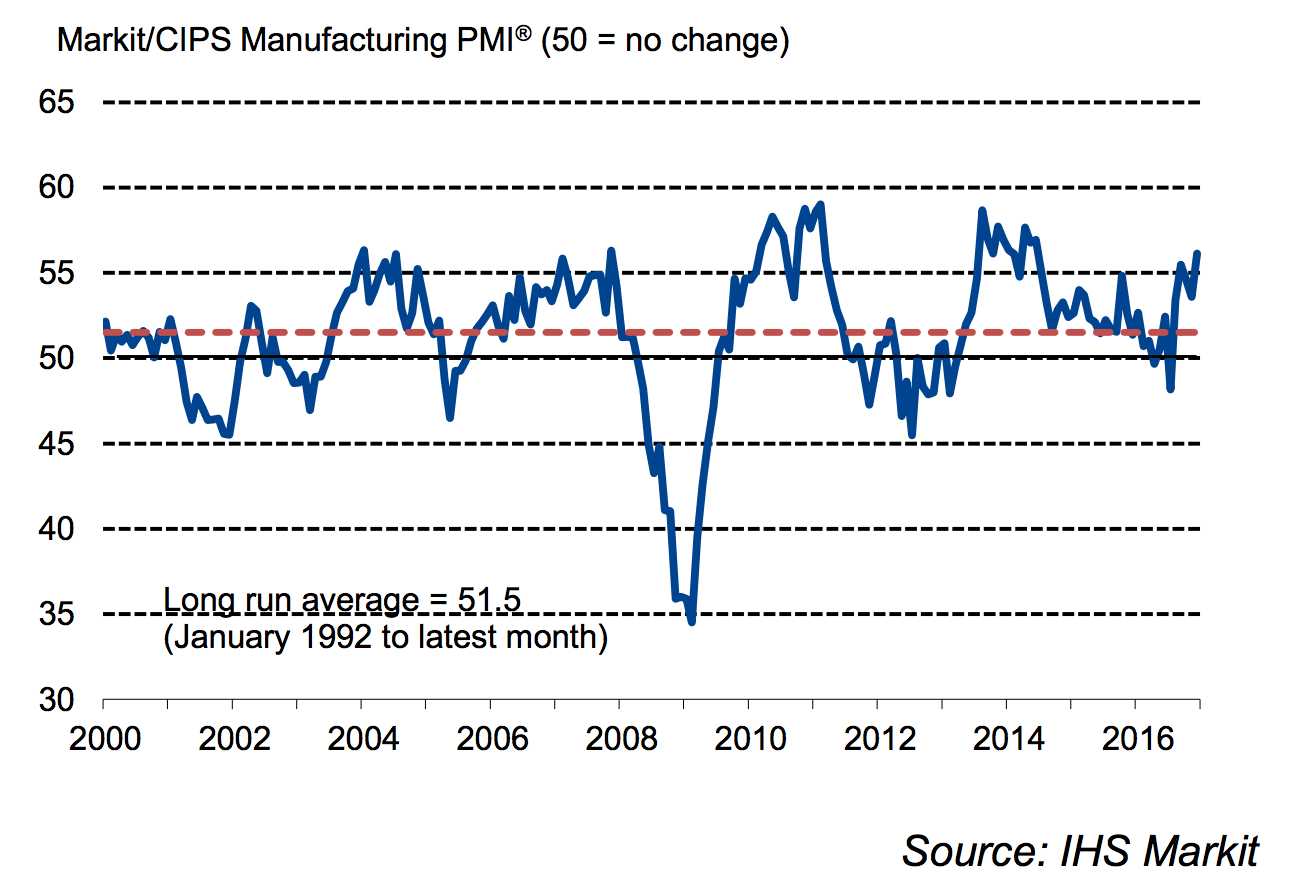
UK manufacturing soars to 30-month high on strong domestic and overseas demand

United Kingdom’s manufacturing sector closed 2016 with a bang, hitting a two-and-a-half-year high in December, an industry survey revealed.

The Markit/CIPS purchasing managers’ index (PMI) went up to 56.1 last month from 53.6 in November. Industry players monitor the seasonally-revised index for signs of expansion or contraction in the manufacturing sector. When the index is at 50 or higher, that means the sector is expanding. Conversely, any figure below 50 indicates contraction.

manufacturing-pmi

UK manufacturing production and new business rose last month, with new export business growing for seven straight months, as British manufacturers reported increased orders from major markets including China, Europe, U.S., and the Middle East.

Not only was last month’s PMI reading the highest in 30 months, it was also the fastest in terms of growth rate for both production and new orders in nearly three years.

The December survey attributes the rise of the index to robust demand from abroad, which was boosted by the weaker pound. The British currency has fallen sharply against rival currencies in the past year, making UK products more affordable for overseas buyers.

The weakened sterling, however, is proving to be a mixed blessing for the sector.  While the pound helped boost the country’s manufacturing sector get off to a strong start this year, cost for British manufacturers remain high due to reduced importing power, the Markit/CIPS survey found.

The weakness of the British currency has nudged the price of imported goods higher, which has translated to higher costs for a number of manufacturers.

The survey noted that price pressures continued to be at elevated levels in December, with inflation for input costs and output charges remaining among the fastest in the survey’s history.

To negate the higher input costs, some manufacturers have started to pass on the burden to their clients by increasing their selling prices, with prices consistently rising over the last eight months.

Some analysts expect these higher costs to push the inflation up in the coming months.

If you are a UK business within the Manufacturing sector looking to boost your company finances, a Part Time FD can provide the direction and financial guidance you need to ensure maximum success. Contact Assured FD Services today to see how we can help.

The post UK manufacturing soars to 30-month high on strong domestic and overseas demand appeared first on Assured FD Services.

Sunday, January 1, 2017

Why Interim CFOs Are The Way To Go…

Hiring high-level professional help can be daunting task for most small and medium sized businesses. According to a recent study, the average annual compensation of a CFO in the UK is £100,944. This prohibitively high cost can impede a small business from hiring a CFO, all the while stopping them from making progress.

A revolution has began in this regime. The rise of many companies that offer on demand financial management are a breath of fresh air to small business owners. You can now hire top level CFOs at a fraction of the cost through consultancy services, as interim CFO.

With the need for adequate financial consulting growing due to stricter government policies for business, these services are the need of the time. With difficult tasks like marketing, sales and customer support already competing for the time and attention available to a small business owner, the added experience and time needed to perform audits, file taxes and manage the company’s financial resources adequately, can become impossible for business owners.

Now with the advent of financial consulting services, companies can acquire the services they need without hiring executives who become a burden to their already strained budgets. However, some may claim that the services offered by such agencies may be sub par. This is far from the truth. In fact, the competitive nature of the market in which they strive to gain contracts guarantees that they provide high quality services. This provides a better alternative to hiring lesser talent at a lower cost, which also results in negligible progress for a company. Thus, interim or part time finance director services are the only way to ensure that you receive high quality work for every penny you pay.

If you are a small business owner and want to make the most of your financial resources, contact Assured FD Services today to use your resources to the fullest potential. This is the best way to ensure that you make the most of your resources and grow your company at the pace you want.

The post Why Interim CFOs Are The Way To Go… appeared first on Assured FD Services.

Wednesday, December 28, 2016

British Consumer Confidence Plummets to Lowest Level Since EU Referendum

Consumer confidence in the United Kingdom dropped this month to its lowest level since the immediate aftermath of the Brexit vote, weighed down by worries over rising inflation pressures, a survey released over the weekend showed.

Polling firm YouGov and the Centre for Economics and Business Research (Cebr) said consumer morale in the country declined by a whole point to 108.1 this month, the lowest level since July this year.

Pollsters found that British consumers were less optimistic about their household finances over the next 12 months due to worries over inflation, which is expected to rise sharply after the UK formally exits the European Union.

Scoot Corfe, Cebr director, says that looming inflation is slowly being felt in the economy at large and by British consumers.

The YouGov/Cebr survey echoed the findings of a separate survey published by GfK the day before which showed a deterioration in consumers’ sentiment for the coming year.

Sterling has shed more than 10 percent of its value against the greenback since June’s Brexit vote, and while a number of businesses have raised prices to compensate for the weakening currency, many are still holding out price increases until after the highly competitive holiday shopping season.

Contrary to predictions of doom, the British economy has done relatively well. Many economists were expecting worse.

However, a rise in inflation in the next 12 months is particularly worrying as it is likely to weaken the spending power of households, a key economic driver. Household spending power helped the UK recover economically during the financial crisis of 2007 to 2009.

Meanwhile, wages are not expected to keep pace with inflation, says XpertHR, a payroll data company.

The Bank of England (BoE) projects inflation to rise within the next 12 months to 2.7 percent from 1.2 percent.

If you are looking for guidance through these uncertain times, contact Assured FD Services today on 07817 676371. Assured FD Services provide specialist part time FD services to UK businesses, strengthening operating stability and strategising for growth.

Image Credit

The post British Consumer Confidence Plummets to Lowest Level Since EU Referendum appeared first on Assured FD Services.

Tuesday, December 20, 2016

Potential Loss of Mutual Enforcement Rules Puts UK’s Legal Sector at Risk

UK’s legal sector, a £25.7 billion industry, could be at risk if the Government is unable to secure guarantees for it after the country leaves the European Union (EU), lobby group TheCityUK warned on Tuesday.

Britain’s legal services sector is preferred by international companies for dispute resolution due to the use of English law in commercial contracts.

EU rules require member states to recognise and enforce UK’s law and vice versa.

This makes Britain a very attractive place to draw up contracts and resolve disputes for many businesses, both local and international. It has become one of the largest legal sectors in the world with four times more turnover than France and two and half times more than Germany. It is second only to the United States.

The potential loss of mutual enforcement rules, which is a likely consequence of the Brexit, could force many companies to look elsewhere for legal services.

The sector, which employs roughly 370,000 people, is now urging the Government to find a solution that will allow mutual enforcement of laws and judgments to continue. It is likewise calling on lawmakers to adopt measures to ensure free movement for legal professionals in the European market, noting the high number of foreign law firms operating in the country.

The group pointed out the adverse effects to other key sectors including financial services, energy, real estate and technology if legal support services are disrupted.

Miles Celic, chief executive of TheCityUK, said it is vital that the key challenges and opportunities for the legal sector are addressed during the Brexit negotiations, and that its competitiveness is not only maintained but enhanced.

The legal services sector added £25.7 billion to the country’s economy last year, comprising 1.6% of UK’s gross domestic product (GDP).

If you are unsure about your business’s financial future then please get in touch. At Assured FD Services we have over 20 years expertise working as a full and part time FD for companies across the UK.

Image Credit

The post Potential Loss of Mutual Enforcement Rules Puts UK’s Legal Sector at Risk appeared first on Assured FD Services.

Friday, December 16, 2016

VAT and Your New Business

All new companies should be made aware that, you can claim VAT on costs incurred before the business started trading This includes VAT incurred on assets used prior to VAT registration.

Subject to the normal rules on VAT deduction:

  • VAT on services received within six months of the effective date of registration (EDR) and used in the business at EDR is recoverable in full
  • VAT on stock is deductible to the extent that the goods are still on hand at EDR (for example, apportionment may be required)
  • VAT on fixed assets purchased within four years of EDR is recoverable in full, providing the assets are still in use by the business at EDR

Full recovery only applies if a business is fully taxable. If a business is partly exempt, has non-business activities or needs to restrict VAT deduction for any other reason, it will need to take that into account when calculating the amount of deductible VAT.

For further advice on Tax Compliance and VAT, contact Assured FD Services today. With over 20 years experience managing the finances of UK market leading companies, you can rely on receiving the best advice and guidance possible.


The post VAT and Your New Business appeared first on Assured FD Services.

Monday, December 12, 2016

UK Economy Set To Lose Momentum

The UK economy is set for a sluggish growth next year as uncertainty over Brexit and rising inflation adversely impact both consumers and businesses, the British Chambers of Commerce (BCC) said in its updated forecast.

The business group projects the UK’s economy to expand by a mere 1.1% in the coming year, and by 1.4% in 2018. Previous forecasts pegged 2018 growth to be at from 1.8%.

The BCC says the country will not fall into recession, but predicts that growth will slow down as import costs rise due to a weak pound. The resulting rise in inflation will then diminish consumers’ spending power, eroding overall economic figures.

Recent data from the British Retail Consortium and Springboard indicate that consumers may already be feeling the pinch. Shopper traffic to the high street and shopping centres plunged in November despite lower prices and Black Friday promotions. Footfall in November was 1% lower compared to the same period last year.

The BCC says the sector that will be most impacted by the economic slowdown would be public finances, particularly tax receipts. It echoes the same projections made the Office of Budget Responsibility, a fiscal watchdog.

The business body expects UK’s inflation to top the Bank of England’s 2% target next year, with a forecast of 2.1% in 2017 and rising to 2.4% in 2018. November inflation figures are due on Tuesday, and are expected to climb to 1.1%.

Business investment is projected to decline by 0.8% in 2016, 2.1% in 2017 and 0.3% in 2018 – slightly better than previously expected, but significantly worse than the 1.9% growth previously forecasted for 2018.

The British Chambers of Commerce also said that export growth was likely to slow down in the coming years before picking up momentum again in 2018. The group said that previous projections on the impact of the weaker pound on UK exports were a bit overstated.

So far, the pound has shed about 15% of its value against the US dollar and roughly 10% against the euro since the Brexit referendum.

If you are looking for expert FD Services in the Leeds & Yorkshire area contact Assured FD Services today.

Image Credit

The post UK Economy Set To Lose Momentum appeared first on Assured FD Services.

Thursday, December 8, 2016

Financial Services Sector Is UK’s Top Tax Payer

The United Kingdom’s (UK) financial services sector paid £71.4 billion in tax last year, accounting for 11.5% of the UK’s total tax collection. This year’s contribution was the highest since 2007, accounting firm PwC noted in its annual report.

Banking institutions and insurance companies were the top contributing sub-sectors, paying an additional £8.4 billion and £3.4 billion respectively, thanks to reforms in corporate tax and the bank levy.

The report, which was commissioned by the City of London, underscores the potential adverse impact to public finances if Brexit limits UK’s access to the European Union’s (EU) single market.

Financial services firms in the UK have expressed concerns about the Brexit’s negative effect on their businesses. Main concerns include losing access to a skilled EU workforce and potential restriction on their ability to trade with the single market, among others.

About 1.1 million people are employed by the financial services sector in the UK, comprising 3.4% of the country’s total workforce.

Many are waiting to see whether the UK can retain “passporting” rights, which enable lenders to continue transact without restrictions across the EU.

Addressing reporters in Brussels on Tuesday, Chancellor Philip Hammond said the government would study the “costs and benefits” of continuing to pay for access to the EU single market after UK formally exits the union, echoing previous pronouncements made by Brexit Secretary David Davis.

Last week, Brexit Secretary David Davis said paying for continued access was a possibility.

Speaking at a tax event on Tuesday, Financial Secretary to the Treasury Jane Ellison acknowledged the concerns of the financial sector, and assured that the government would be negotiating for an deal that will help UK’s financial services sector to be “every bit as successful after our withdrawal as before.”

She adds that Brexit could also mean “new opportunities” for this economically-vital sector.

Assured FD Services

The post Financial Services Sector Is UK’s Top Tax Payer appeared first on Assured FD Services.

Monday, December 5, 2016

Why Businesses Are Still Considering Exporting


Following on from our previous article “Thinking Of Expanding Your Business?“, as more and more businesses are focussing on strengthening their future growth strategies, one very apparent but often overlooked scheme is exporting goods and services overseas. Most are put off by their perception of the complexity and scale of such a project, however with the right direction and determination, huge opportunities exist.

In the following article, Ben Lobel details the emergence of business expansion overseas back in 2015.

By 2025, 880,000 (17 per cent) British small businesses plan to expand overseas – an increase from the 10.8 per cent of small businesses currently taking advantage of additional export revenues.

In 2015 Annual Business Survey figures show that a third of medium-sized businesses and 41 per cent of large businesses currently take advantage of export growth. Small businesses should work with industry bodies like the UKTI to see what opportunities exist and get advice on how to grow their business overseas. Click here to read more.

So how do we feel now as we approach 2017? As we discussed in our previous article “Business Confidence and Strategy Following The Brexit Vote” even with an uncertain European relationship, it seems exporting goods and services still remains an option considered for business growth. Praseeda Nair offers her thoughts on why this might be and the benefits of looking overseas.

A little international expansion goes a long way for a growing business. For starters, it provides a great deal of flexibility about how you present your organisation. Fourth Day, for example, has five offices across four different countries, which makes us sound quite large. Every office, however, contains fewer than ten people, which makes us seem quite small. It’s the best of both worlds – an international team that is nonetheless sufficiently close knit that everyone knows everyone else.

Secondly, as a service-based company, we’ve found that more than one office is a big help in terms of balancing our income and workload. This is particularly true of our Manchester and London offices, where spare capacity in one place can easily be used by the other. Internationally, we have had the opportunity to secure business across borders and to make referrals between offices. In our case, we have found that our European offering can be attractive for US companies venturing into Europe.We’ve expanded slowly but steadily over the past 14 years and have learned a few things that might be helpful if you’re considering taking the plunge into a new territory. Click here to read more…

The growing popularity and success stories show that exporting can be a hugely lucrative opportunity, if implemented correctly.

If you are a UK business contemplating overseas expansion, a Part Time FD can provide the direction and financial guidance you need to ensure maximum success. Contact Assured FD Services today to see how we can help.

Image Credit

The post Why Businesses Are Still Considering Exporting appeared first on Assured FD Services.

Monday, November 28, 2016

UK firms ramp up investments amid Brexit worries  

British businesses appear to have shrugged off worries over the Brexit vote, increasing investments by a rate of 0.9 percent over the last three months, according to official government data released on Friday.

Earlier this year, the pound plunged after the Brexit referendum results became clear.

Economists expected the resulting inflation to slow down UK’s economic growth, but the latest data from the Office for National Statistics seem to be showing a different picture.

The increase in capital spending, which helped push the UK economy forward, beat earlier expectations of a 0.6 percent increase. The growth projection was based on a poll of economists conducted by Reuters.

The rise in investments was supported by a rebound in British exports as well as a sizeable increase in household spending, the ONS said in its report.  Overall, Britain’s economy nudged higher by 0.5 percent three months following the June referendum, where the vote to leave the European Union won.

The ONS, however, cautioned that most of the investment data covered by Friday’s report probably included expenditure decisions made prior to June’s vote.

Meanwhile, a separate survey by the Confederation of British Industry shows that UK retail sales likewise trended positively, rising at its quickest rate in more than a year in November. Experts project strong consumer spending to continue until the fourth quarter, driving economic numbers up.

While big firms such as Google, Facebook and Nissan have indicated their intentions to invest in Britain despite the uncertainty over the decision to leave the EU, recent surveys show that smaller companies are holding back plans for capital spending until economic outlook improves.

Anticipating a slow down in private investments in digital infrastructure, transportation and housing sectors in the near term, finance minister Philip Hammond said this week that his office will be borrowing 23 billion pounds to fund investments in these sectors over the next five years.

If you are unsure about your business’s financial future following the Brexit vote then please get in touch. At Assured FD Services we have over 20 years expertise working as a full and part time finance director for companies across Leeds & Yorkshire, aswell as the rest of the UK.

The post UK firms ramp up investments amid Brexit worries   appeared first on Assured FD Services.

Saturday, November 26, 2016

Thinking Of Expanding Your Business?

Once a business is established and making a profit on the products and services sold, it is only natural for a business owner to begin thinking how to manage and bolster growth. It can be an exciting but challenging time – protecting what you already and building upon that with minimal disruption to it is the key to successful expansion. It is also important to remember that there will be areas of opportunity to reduce costs and increase margins as a business develops, so capitalising on these will be key to maximising your success.

It is important to understand the types of business growth and the methods you may wish adopt to achieve it. It is in the interest of the government is encourage and provide support for business growth, as it benefits the economy overall, therefore they themselves have offered an overview and guidance on the topic. The following article can be found on the government website.

Growing your business

Once your business is established and you’re making a profit on the products and services you sell to customers, you may want to start thinking about how to grow.

Many businesses think of growth in terms of increased sales, but it’s also important to focus on how to maintain or improve your profitability.Things you can do to help grow your business include:

  • looking into ways of increasing your sales, both to existing customers and new customers
  • improving your products and services by researching and testing changes with your customers
  • developing new products and services, and selling them to new or existing markets
  • taking on staff or training your current staff, including working with apprentices and mentors
  • looking for additional sources of funding, such as bringing in new investors
  • thinking about selling your products or services online
  • work with a business mentor, who can help you think about how to do all of these things

You can find more information here.

In the following article, Sarah Willingham, owner of MizMoz, Craft Gin Club and MySupermarket, offers her insight from her personal experiences of business growth, and how to best approach the challenges of expansion.

Ready or not: what to do about expansion

Achieving success is front of mind for entrepreneurs when embarking on a new business venture. The initial stages can often be expensive and time-consuming, and business owners naturally want to see that the investment they are making will have a quick return.

Often, it is the idea of expansion that business owners find particularly challenging to navigate. To help with this process, I’ve developed a series of tips to help entrepreneurs recognise when the time is right to move into the next phase of their journey and overcome the barriers to growth to reach their full potential.

Expansion means different things to different businesses. For some it would be adding another shop to a chain, for others it might be starting to operate online. Whatever the goal, it often doesn’t come cheap, and therefore getting help from investors could be key to your success. To get new investors on board, you need to articulate three things: who the business is aimed at, why consumers would buy from it, and why you, as the business owner, are the person to make it work.

Often, it is the idea of expansion that business owners find particularly challenging to navigate. To help with this process, I’ve developed a series of tips to help entrepreneurs recognise when the time is right to move into the next phase of their journey and overcome the barriers to growth to reach their full potential.

To read the full article click here.

Sarah has offered some helpful information relating to her own personal journey of business expansion. Experience in priceless is these situations, so you should surround yourself with the right people and the right advice. You could even consider the services of an interim FD to guide you through the process.

If you are a UK business looking to grow, but are a little unsure about funding options, the government offers grants and loans to those who meet a certain criteria. You can click here to find out what funding schemes you may be eligible for, but I would also suggest contacting your local expert.

I would like to finish out with a summary made by Sarah Willingham.

Ultimately, in every aspect of success – from setting up, to growth, to ongoing innovation – the most important advice I can give is to listen to your customer. Find out what works best for them, and how you can meet their needs. There is no substitute for loyal, engaged customers who feel valued. Then prove your commitment by adapting your business. Only by getting the basics right first, and always keeping customers front and centre, can businesses achieve lasting growth and take that next step

The post Thinking Of Expanding Your Business? appeared first on Assured FD Services.

Saturday, November 19, 2016

Auto-Enrolment for Small Businesses

A commonly held perception is that pension schemes for staff are only required for companies with a lot of employees and a high turnover. However, by virtue of the law passed in 2012, auto-enrolment into a company pension scheme is mandatory for every business type, be it on a big scale or small. It is obligatory that every employee of the company has the facility to be a member of a pension scheme.

There has been a hefty amount of penalty and fines imposed if the business owner fails to fix up the auto-enrolment scheme for their staff.

Based on the issued rules and regulations, the daily fine charged can range from £50 to £2,500 based on the total number of employees.  Recently, PayCircle estimated that UK businesses could face fines totaling £22 million in auto-enrolment fines.

View this short video from the Pensions Regulator about Auto Enrolment for employers.

If you require any assistance or guidance on setting up a pension scheme arrangement within your company, consult with a professional part time FD from Assured FD Services.

The post Auto-Enrolment for Small Businesses appeared first on Assured FD Services.